Web Hosting Renewal Prices in 2026: Which Hosts Renew Fairly?
I compared what ten web hosts charge after the first term: which ones renew fairly, what three years really cost, and how to avoid surprise renewal fees.
·22 min read
Namecheap, IONOS and DreamHost have the fairest web hosting renewal prices of the ten
hosts I checked: each prints the renewal on the plan card, and theirs are the three
lowest renewals I could confirm. Where both prices were shown, entry plans renewed at
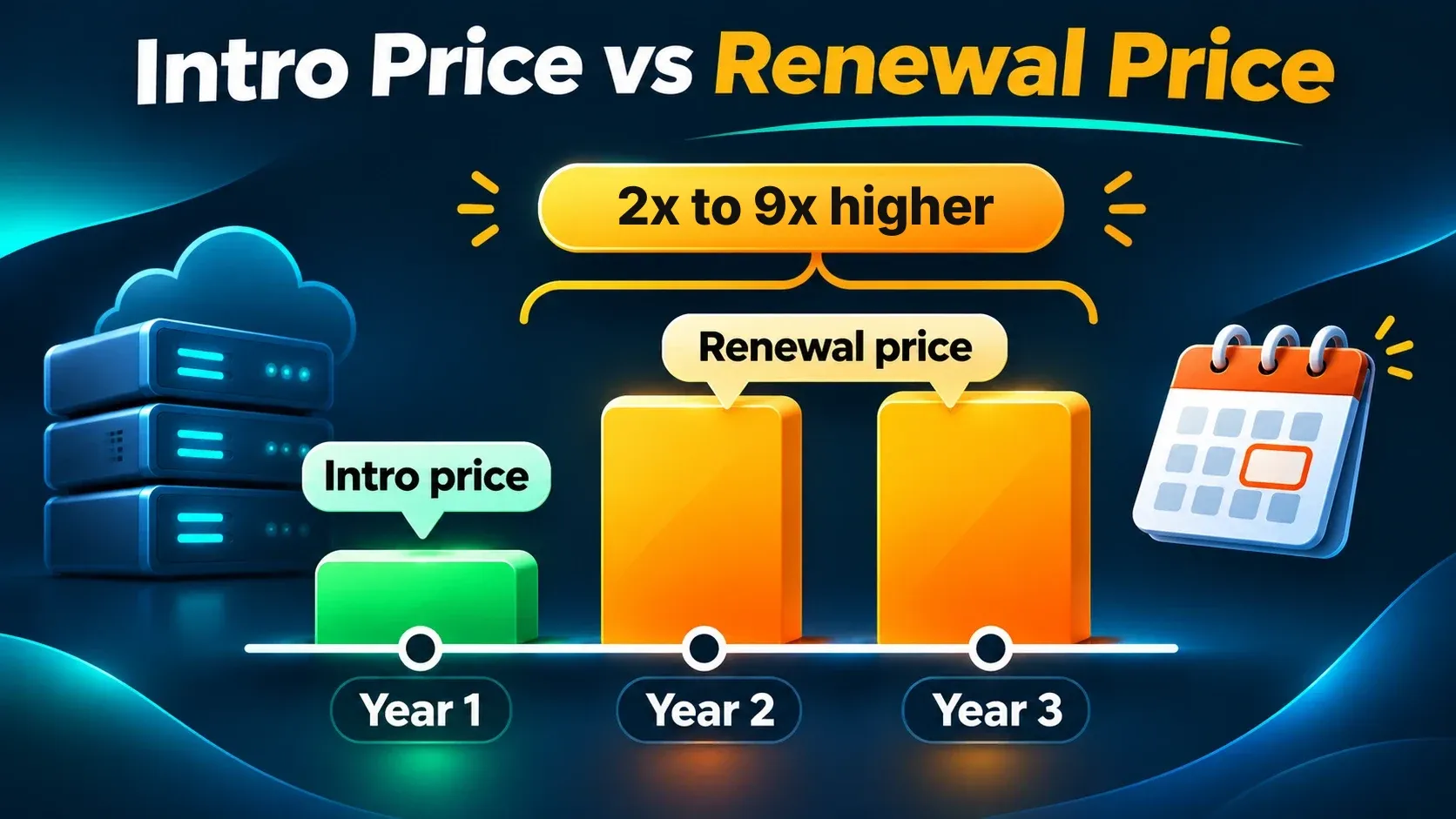
2 to 9 times their first price.
I build WordPress sites and run several of my own and client sites on one Hostinger
plan. I read each host’s own pages on November 24, 2026, in US dollars, before tax; the
notes under the table cover any page that would not load for me.
One link, to Hostinger, is an affiliate link: I may earn a commission.
It was Black Friday week when I checked, so several first-term prices below are sale
prices. The renewal prices are the regular rates you pay after that.
Which Web Hosting Companies Have Fair Renewal Prices?
Namecheap, IONOS and DreamHost have the fairest renewal prices of the ten hosts I
checked. All three print the renewal on the plan card, and they had the three lowest
renewals I could confirm: $55.88 a year at Namecheap (about $4.66 a month), $8 a month
at IONOS, and $7.99 a month at DreamHost after a four-year term.
Here is my ranking for a small site, judged on the renewal price, how far it
jumps, and how openly it is shown:
Namecheap Stellar renews at $55.88 a year, about twice its first year: the lowest
renewal I could confirm.
IONOS Essential renews at $8 a month after $4 a month in year one, with no Black
Friday sale behind it. It is the only host to pass all four points of my test.
DreamHost Launch renews at $7.99 a month after four years, or $10.99 after one,
printed under every price. Daily backups are included.
Bluehost Starter renews at $9.99 a month on 36 months, 2.5 times its first price,
but its own page shows two different 12-month renewal prices.
Hostinger Premium renews at $10.99 a month, printed under every plan and term.
The jump from the $1.99 Black Friday price is 5.5 times.
HostGator Hatchling renews at $12.79 a month after 36 months, 3.4 times its first
price, and only that term is shown.
GreenGeeks and SiteGround print their renewal clearly too, but it is 7.7 and 9 times
their sale price. I could not confirm InMotion’s or hosting.com’s renewal, because their
pricing pages did not load fully for me (see the notes under the table).
Web Hosting Renewal Prices Compared (2026 Table)
The entry plans that showed a price started at $1.49 to $4 a month in November 2026
and, where the renewal was shown, renewed at $4.66 to $17.99 a month. The table shows each host’s cheapest shared hosting plan, how long
you must prepay to get the intro price, and what a .com domain renews at with that host.
Intro price, renewal price and .com renewal for ten hosts' entry plans, November 24, 2026, in US dollars
Namecheap prices by the year. Its card says $26.88 for the first year and
“renews at $55.88/year”; the $4.66 is that renewal divided by 12, and the +108%
compares the $26.88 first year with the $55.88 renewal. Its .com renewal is $19.98
plus a $0.20 ICANN fee.
Bluehost’s own page disagrees with itself. Its plan card says Starter renews at
$13.79 a month after a 12-month term, while the Renewal Pricing table on the same page
says $11.99.
SiteGround’s and InMotion’s pricing pages would not load for me. SiteGround’s
figures come from its own pages as they appeared in search results that day.
InMotion’s pages, as indexed by search, showed several different prices, so check its
page before you buy.
hosting.com’s prices did not load for me when I checked. Its Black Friday page
advertised “from $1.49/mo on 12-month plans” (its home page, as shown in search
results, ties that price to Starter), and hosting.com says the renewal is the regular
price, shown before you pay.
Two .com prices come from help pages. Namecheap’s .com price list did not load in
my browser and GreenGeeks’s domains page shows no price, so their .com renewals
($19.98 and $17.95) come from their own help pages as shown in search results that day.
Why Does Web Hosting Cost More at Renewal?
Web hosting costs more at renewal because the first price is a discount to win you as a
customer, and it only lasts for the first term. When that term ends, the plan renews at its regular price.
On November 24, 2026, the eight entry plans that showed both prices renewed at about 2 to 9 times their first-term price.
The intro price is a sign-up discount. It applies once, to the first term you
prepay. Nothing about the plan changes at renewal except the price.
A longer first term buys a lower monthly figure, and a bigger bill later. The
lowest advertised price often needs 36 or 48 months paid upfront. You save during
those years, then renew at the full rate, and Hostinger renews for the same long
term, so the renewal bill is larger too.
Some hosts renew cheaper on a long renewal term than on 12 months. Bluehost’s
Starter plan renews at $9.99 a month for 36 months, $11.99 for 12 months and $15.99
month to month. At DreamHost the first term sets the rate: Launch renews at $7.99 a
month after four years and $10.99 after one, and the card does not say how long the
renewal runs. So the term matters, at sign-up and at renewal.
What Makes a Renewal Price “Fair”? (My 4-Point Test)
A renewal price is fair when you can see it before you pay, it is not a shock next to
what you paid first, the basics are already included, and you are not locked in to get
a reasonable rate. Hosts with fair renewal prices pass most of these four points, and
I score every host on them below.
Renewal is published on the plan card before checkout
You should not have to reach the checkout to learn what the plan costs in year two. The
fair version prints the renewal next to the intro price, on the plan card itself.
Renewal is no more than about 3x the intro price
Every host raises the price after the first term. A renewal of two to three times the
first price is normal for shared hosting. Past that, the intro price is doing most of the
selling. Black Friday prices make every jump look bigger, so I note the regular intro
price where a page showed one.
SSL, backups and email are included, not added later
A cheap plan that needs a paid SSL certificate, paid backups or paid mailboxes is not
cheap at renewal. Count only what the plan includes, and for how long.
A monthly or 12-month option exists, so you are not locked in
A fair host lets you renew for a year, or pay monthly, at a published price. If the
only reasonable rate needs another three or four years upfront, you are paying for
loyalty in advance. For clear monthly pricing, Hostinger and DreamHost both published a
month-to-month rate: Hostinger’s Premium at $12.99 a month with no jump, and DreamHost’s
Launch at $4.99 a month for three months, then $11.99.
Here is how the ten hosts scored:
Each host's entry plan scored on the 4-point fair renewal test
Host
Renewal on the plan card
Renewal under about 3x
SSL, backups and email included
Monthly or 12-month option
Hostinger
Renewal on the plan cardPass, for every term
Renewal under about 3xFail: 5.5x the sale price
SSL, backups and email includedPartly: weekly backups, email free for 1 year
Monthly or 12-month optionPass
Bluehost
Renewal on the plan cardPartly: card and renewal table disagree
Renewal under about 3xPass: 2.5x on 36 months
SSL, backups and email includedPartly: weekly backups, 1-month email trial
Monthly or 12-month optionPass
SiteGround
Renewal on the plan cardPass
Renewal under about 3xFail: 9x
SSL, backups and email includedPass: daily backups and email
Monthly or 12-month optionPass: 12 months
Namecheap
Renewal on the plan cardPass
Renewal under about 3xPass: 2.1x
SSL, backups and email includedPartly: SSL certificates free for the first year, backups twice a week
Monthly or 12-month optionPass
DreamHost
Renewal on the plan cardPass, for every term
Renewal under about 3xFail: 4.5x
SSL, backups and email includedPartly: email free for 3 months
Monthly or 12-month optionPass
GreenGeeks
Renewal on the plan cardPass
Renewal under about 3xFail: 7.7x the sale price (5.1x from the $2.95 its page shows struck through)
SSL, backups and email includedPass: daily backups and email
Monthly or 12-month optionPass: 12 months
InMotion Hosting
Renewal on the plan cardCould not check
Renewal under about 3xCould not check
SSL, backups and email includedCould not check
Monthly or 12-month optionCould not check
HostGator
Renewal on the plan cardPass
Renewal under about 3xFail: 3.4x
SSL, backups and email includedPartly: courtesy backups (frequency not stated), email trial
Monthly or 12-month optionPartly: only 36 months shown
hosting.com
Renewal on the plan cardCould not check
Renewal under about 3xCould not check
SSL, backups and email includedPass: daily backups, SSL and email
Monthly or 12-month optionPartly: 12-month plans, renewal price not seen
IONOS
Renewal on the plan cardPass
Renewal under about 3xPass: 2x
SSL, backups and email includedPass: SSL, automatic backups, 1 mailbox
Monthly or 12-month optionPass: 1-year term
IONOS is the only host that passed all four. Namecheap and Bluehost passed on the size of
the jump, and Hostinger and DreamHost were the most open, printing the renewal for every
term. For all-in-one hosting, with SSL, backups and email in the plan, the entry plans of
SiteGround, GreenGeeks, hosting.com and IONOS included all three.
The True 3-Year Cost of Popular Hosting Plans
Over three years on 12-month terms, the seven entry plans I could price cost between
$138.64 (Namecheap Stellar) and $455.64 (SiteGround StartUp), before the domain. The
first-year price barely matters to the true cost of web hosting: years two and three
are where the money goes.
A worked example. Hostinger Premium on the 12-month term was $1.99 a month during
the sale, so year one costs $23.88. It then renews at $10.99 a month for the same term,
so years two and three cost $131.88 each. Three years: $23.88 + $131.88 + $131.88 =
$287.64. On the 48-month term at the same sale price, you would pay $95.52 once and
not renew until year five. The same math for Namecheap’s Stellar, billed yearly: $26.88 +
$55.88 + $55.88 = $138.64. For SiteGround’s StartUp: $23.88 + $215.88 + $215.88 =
$455.64.
Three-year cost of each entry plan on 12-month terms, in US dollars, before the domain
Host
Year 1
Year 2
Year 3
3-year total
Namecheap Stellar
Year 1$26.88
Year 2$55.88
Year 3$55.88
3-year total$138.64
IONOS Essential
Year 1$48.00
Year 2$96.00
Year 3$96.00
3-year total$240.00
Hostinger Premium
Year 1$23.88
Year 2$131.88
Year 3$131.88
3-year total$287.64
DreamHost Launch
Year 1$23.88
Year 2$131.88
Year 3$131.88
3-year total$287.64
Bluehost Starter
Year 1$50.88
Year 2$143.88
Year 3$143.88
3-year total$338.64
GreenGeeks Lite
Year 1$23.40
Year 2$179.40
Year 3$179.40
3-year total$382.20
SiteGround StartUp
Year 1$23.88
Year 2$215.88
Year 3$215.88
3-year total$455.64
Year 1 is each host’s 12-month intro price, times 12 (Namecheap shows the yearly total). Years 2 and 3 are the 12-month renewal price, times 12, as shown on November 24, 2026, before tax. Bluehost uses the $11.99 from its renewal table; with the $13.79 on its plan card, its three years come to $381.84. IONOS, GreenGeeks and DreamHost do not say which term their renewal price is for, so years 2 and 3 assume it is a yearly renewal. HostGator, InMotion and hosting.com are left out because I could not read a 12-month intro price and renewal together on their pages.
Three-year cost of the entry plan, on 12-month terms (lower is cheaper)
Prices from each host’s own pages, November 24, 2026, USD, before tax
Namecheap, renews $55.88/yr, $138.64
IONOS, renews $8/mo, $240.00
Hostinger, renews $10.99/mo, $287.64
DreamHost, renews $10.99/mo, $287.64
Bluehost, renews $11.99/mo, $338.64
GreenGeeks, renews $14.95/mo, $382.20
SiteGround, renews $17.99/mo, $455.64
0250500 USD
Calculated from the table above: the 12-month intro price for year 1, then the 12-month renewal price for years 2 and 3. The bars start at zero.
The cheapest first invoice is often not the cheapest host. SiteGround’s StartUp and
Hostinger’s Premium both cost $23.88 for the first year at their sale prices, yet
SiteGround’s three years cost $168 more, because of its renewal. Namecheap’s first year
costs more than either, and its three years cost the least. That is why I read web
hosting renewal prices before the first-term price.
Hosts With Transparent Renewal Pricing (Shortlist)
My shortlist for transparent renewal pricing is Hostinger, DreamHost, Namecheap, IONOS
and GreenGeeks. Each prints the renewal price on the plan card, right next to the price
you pay first, so you see the year-two price before you pay.
Hostinger: the renewal for every term, under every plan
Hostinger
Premium: 3 websites, 20 GB SSD storage
First term
$1.99/month
Black Friday price, 12 to 48 months
Renews at
$10.99/month
for the same term
Backups
Weekly
daily is a paid add-on
Hostinger prints the renewal under the button on every plan and for every term, for
example “Today you pay $95.52 for 48 months. Renews at $10.99/mo for the same term.”
Premium renews at $10.99 a month and Unlimited at $16.99.
The catch: the jump from the Black Friday price is 5.5 times, Premium’s backups are
weekly, and its free mailboxes last one year. Best for: one to three small sites
where you want the renewal stated plainly. It is what I use for my own sites and client
sites. See Hostinger’s pricing page (opens in a new tab).
DreamHost: “renewal prices shown upfront”
DreamHost
Launch: 25 websites, 25 GB NVMe storage
First term
$1.79/month
Black Friday price, 4 years
Renews at
$7.99/month
after 4 years
Backups
Daily
DreamHost’s page promises “Renewal prices shown upfront”, and it keeps the promise: every
card, on every term, ends with a line such as “Auto-renews at $7.99 /mo after 4 years.”
The catch: email is free for the first three months only, and the card does not say
for how long the renewal rate runs. Best for: several small sites that need daily
backups. See DreamHost’s web hosting plans (opens in a new tab).
Namecheap: the lowest renewal here
Namecheap
Stellar: 3 websites, 20 GB SSD storage
First year
$26.88
yearly-billing price, before coupon
Renews at
$55.88/year
about $4.66 a month
Backups
Twice a week
not guaranteed
Namecheap shows the total you pay today and the yearly renewal side by side on the card,
“You pay $26.88” and “renews at $55.88/year”. Stellar Plus, with unlimited websites,
renews at $85.44 a year. The card also offers a Black Friday coupon (“Save 78% with coupon”), whose price is shown only at
checkout; with it the first year costs less, so the jump to $55.88 is bigger than twice.
The catch: Stellar’s backups are “ideally performed twice a week, though not
guaranteed”, and the free SSL certificates are for the first year. Best for: one to
three small sites on the tightest budget. See Namecheap’s shared hosting plans (opens in a new tab).
IONOS: a renewal exactly twice the first price
IONOS
Essential: 100 GB NVMe storage
First year
$4/month
1-year term
Then
$8/month
Backups
Automatic
frequency not stated
IONOS puts “Then only $8/month” right under “$4 /month with a 1-year term” on the
Essential card, and there was no Black Friday sale behind the price.
The catch: Essential includes one email address, the card does not say how often
backups run, and it does not say which term the $8 is for. Best for: a single site
where you want a predictable bill. See IONOS web hosting (opens in a new tab).
GreenGeeks: clear, but a big jump
GG
GreenGeeks
Lite: 5 websites, 25 GB web space
First year
$1.95/month
Black Friday price, 12 months prepaid
Renews at
$14.95/month
Backups
Daily
GreenGeeks prints “Pre-paid for 12 months. Renews at $14.95/month” under the Lite
price, and its struck-through “original price” is the same $14.95.
The catch: the renewal is 7.7 times the sale price, and the page offers only the
12-month term. Best for: daily backups on up to five sites, if $14.95 a month fits
your budget after year one. See GreenGeeks shared hosting (opens in a new tab).
Hidden Renewal Costs Beyond the Hosting Plan
The hosting plan is often only part of the renewal bill, even at hosts with fair renewal
prices: the domain, email, backups, domain privacy and checkout add-ons can each renew at
their own price. These are the lines to check on a renewal invoice.
Domain renewal (free first year only)
A “free domain” is free for the first year. After that it renews at the host’s normal
domain price, and often on a different date from the hosting, so you get two renewal
bills instead of one. A .com renewed at $17.95 at GreenGeeks, $19.98 at Namecheap
(plus a $0.20 ICANN fee), $19.99 at Hostinger, $20 at IONOS, $21.99 at DreamHost, $22.99
at HostGator and $23.99 at Bluehost, a year.
Registrars must send you renewal reminders before a .com expires, under
ICANN’s expired registration policy (opens in a new tab),
so keep the email address on your domain account current.
Keeping the domain and the hosting with one company puts both bills in one place, which
is simpler to manage, and each of the seven hosts above sells both. It is not always the
cheapest home for the domain, so compare its renewal price too.
Email accounts
Free email often comes with an end date. Hostinger’s Premium includes mailboxes free for
the first year, DreamHost’s plans include email free for three months, and Bluehost’s
Pro Email is a one-month free trial. After that, email is a separate charge (per mailbox at Hostinger and DreamHost).
Backups and restore fees
Check how often backups run, how long they are kept, and whether a restore costs extra.
Hostinger’s Premium and Bluehost’s Starter include weekly backups, with daily backups
as a paid add-on. DreamHost and GreenGeeks include daily backups on their entry plans.
Domain privacy and SSL upsells
Every entry plan I could check comes with free SSL (Namecheap’s free certificates cover
the first year), so a paid SSL certificate is rarely needed for a normal website. Domain privacy is often extra: Bluehost lists it at
$15 a year per domain, so check whether your host includes it or charges for it.
Auto-added add-ons at checkout
Security scanners, extra backups, SEO tools and “priority” support are sometimes added to
the cart for you. Each one renews too. Remove what you will not use before you pay, and
read the renewal invoice for anything you do not recognize.
Best Value Hosting After Renewal, by Use Case
Judged on the renewal price, not the intro price, Namecheap’s Stellar is the best value
for a blog, CMS site or portfolio, and DreamHost’s Launch for several sites that need
daily backups. For picks that weigh more than the renewal price, see my
overall hosting picks.
For blogs and CMS sites
For one to three WordPress or other CMS sites, Namecheap’s Stellar renews lowest, at
$55.88 a year, with backups twice a week. If you want daily backups included, DreamHost’s
Launch renews at $10.99 a month after a year, or $7.99 after four, and allows up to 25
websites.
For a portfolio with a custom domain
Add the domain’s renewal to the hosting renewal cost before you compare. Over a year of renewals,
Namecheap’s Stellar plus a .com there costs about $76, against about $152 for
Hostinger’s Premium with its .com on the 12-month term. A portfolio rarely needs more than the entry plan.
For agencies managing client sites
For many client sites on one account, look at the plans with unlimited or high site
limits: Hostinger’s Unlimited renews at $16.99 a month with daily backups and 50 GB of
NVMe storage, DreamHost’s Growth renews at $8.99 a month after four years for up to 50
websites, and Namecheap’s Stellar Plus renews at $85.44 a year with unlimited websites.
For PHP developers
Shortlist on the renewal price, then check SSH, Git and the choice of PHP version on the
plan page, because those vary by plan and change often. On renewal price alone, I would
start with Namecheap’s Stellar ($55.88 a year) or Stellar Plus ($85.44 a year, unlimited
websites), or DreamHost’s Launch ($7.99 a month after four years).
For sites that need room to grow
If traffic is growing, plan for the next plan’s renewal, not the entry plan’s.
Hostinger’s Unlimited renews at $16.99 a month and its Cloud Startup at $25.99;
DreamHost’s Growth renews at $8.99 after four years. Before you buy, check how the host
charges for an upgrade in the middle of a prepaid term.
How to Avoid Surprise Renewal Fees (6 Steps)
You avoid surprise renewal fees by knowing the renewal date and price before they
arrive, and deciding on purpose instead of letting auto-renew decide for you.
Note the renewal date the day you buy. Put it in your calendar, with a reminder
30 days before.
Compare renewal prices, not intro prices. The renewal is what you pay for most
of the time you use the host.
Turn off auto-renew 30 days before, then decide. You can switch it back on, or
renew by hand on the term you choose.
Ask support for a renewal or retention discount. Some hosts will offer one to
keep a customer. Ask before the renewal date, not after it.
Remove add-ons you do not use. Each one renews at its own price.
Move to a new host’s intro deal if the math works. Count the time a migration
takes, and the fact that the new host renews at its full price later too.
My Hosting Bill Keeps Going Up: Renew or Switch?
Renew when the renewal price still fits and the host does what you need. Switch when
the yearly saving is worth more to you than the time and risk of moving.
If you switch to cut the bill, the lowest published renewals I found were Namecheap’s
Stellar at $55.88 a year, DreamHost’s Launch at $7.99 a month after a four-year term and
IONOS’s Essential at $8 a month. Compare the new host’s renewal, not its first price,
with what you pay now.
When to renew your hosting and when to switch, by situation
Your situation
Renew
Switch
One small site
RenewIf the renewal fits your budget and the site does what you need
SwitchIf a host with a lower renewal does the same job; moving one small site is quick
Five or more sites
RenewIf one plan still holds them all, since one renewal covers every site
SwitchOnly with a plan ready that fits all of them, and time to move them carefully
An online store
RenewUsually: moving a live store risks orders and payments
SwitchWhen the store has outgrown the plan, in a quiet week, with a full backup
Client sites
RenewIf clients are happy and the cost is built into your fee
SwitchWhen a plan with more sites and daily backups costs less per site
Traffic is growing
RenewIf the next plan up at the same host fits your budget
SwitchIf the host’s bigger plans renew far higher than a rival’s
A tight budget
RenewOn the longest renewal term you can afford, which is often cheaper per month
SwitchTo a host with a low published renewal, not just a low first price
What I Learned Running Several Sites on One Hosting Plan
Running several of my own sites and client sites on one Hostinger plan taught me two
things about renewals: one shared renewal is easier to carry than several, and backups
and security are worth keeping when the price goes up.
Several small sites on one plan make the renewal easier to carry. One renewal
covers all of them, so the cost per site stays low even at the regular price. The
trade-off is that they share one plan’s resources, so a busy site can slow the others.
Backups and security earned their price. When one site looked like it had been
hacked, the backups and security tools on the plan were what I was glad I had paid
for. I would not drop them to make a renewal cheaper.
My advice: compare web hosting renewal prices first and the sale price last. Choose
the plan whose renewal you are happy to keep paying, note the date, and decide before it
arrives. For my overall picks, see my guide to the best web hosting,
and the rest of what I use is in the hosting tools I recommend. How I
handle paid links is explained in my affiliate disclosure.
Last updated: November 24, 2026. Hosts change prices often, so check the plan page before
you pay. If a price here is out of date, tell me and I will correct it.
Common questions
Which web hosting companies have the fairest renewal prices?
Of the ten hosts I checked on November 24, 2026, Namecheap, IONOS and DreamHost renewed most fairly for a small website. Namecheap's Stellar plan renews at $55.88 a year, IONOS's Essential at $8 a month after $4 a month in the first year, and DreamHost's Launch at $7.99 a month after its four-year term. All three print the renewal price on the plan card, before checkout. Hostinger is just as open about its renewal. On one year it costs the same as DreamHost ($1.99, then $10.99), but on four years it renews at $10.99 against DreamHost's $7.99, and its entry plan has weekly rather than daily backups.
How much does web hosting cost after the first year?
For the entry plans I checked on November 24, 2026, renewals ranged from $55.88 a year (Namecheap's Stellar, about $4.66 a month) to $17.99 a month (SiteGround's StartUp), and most renewed at about $8 to $15 a month. Add the domain: a .com renewed at $17.95 to $23.99 a year at the same hosts.
Why is my hosting renewal so expensive?
Hosting renewals cost more because the first price was a sign-up discount that only covered your first term. At renewal you pay the host's regular rate. The jump is biggest when you took a long prepaid term at a sale price, and the bill grows further if a free domain, a free email trial or paid add-ons renew with it.
Can I get the intro price again when I renew?
Usually not. Hostinger's billing help says that all billing cycles after the initial purchase are billed at the regular rate, and Namecheap says its hosting promotional prices do not apply to renewals. What you can do is ask support for a renewal discount before the renewal date, or compare what a new host charges, counting its own renewal too.
Is it worth switching hosts to avoid the renewal price?
It is worth it when the yearly saving is bigger than the cost of moving: your time, any migration fee, and the risk of breaking email or the site for a day. Remember that the new host's intro price ends too. Compare what each host costs over three years, not what the first invoice says.
Which hosts have transparent renewal pricing?
On November 24, 2026, Hostinger, DreamHost, Namecheap, IONOS, GreenGeeks, HostGator and SiteGround printed the renewal price on the plan card, next to the first price. Hostinger and DreamHost showed it for every billing term. Bluehost printed one too, but its plan card and its own renewal table gave different 12-month renewal prices.
Does a free domain renew at a higher price too?
Yes. The free domain that comes with a hosting plan is free for the first year only, and then renews at the registrar's normal price. On November 24, 2026, a .com renewed at $19.99 a year at Hostinger, $21.99 at DreamHost and $23.99 at Bluehost, on top of the hosting renewal.
Is a 48-month hosting plan better value than 12 months?
If you are sure you will keep the site for four years, usually yes, because the low price is locked in for longer. On November 24, 2026, DreamHost's Launch plan was $1.79 a month for four years, renewing at $7.99, against $1.99 for one year, renewing at $10.99. The catch is the larger payment upfront: you commit to four years of hosting on day one.