
Skip to content
Shakawat Hridoy

SEO

A freelance SEO consultant, including the recovery work most avoid

SEO has a bad reputation because it is easy to sell and hard to verify. I work the other way around: fix what is technically broken, publish things people are actually searching for, and show you the search data so you can check my work.

Illustration of a search results page under a magnifying glass, with content cards, a rising bar chart and traffic graphs around it

Built in

  • Google Search Console
  • GA4
  • Screaming Frog
  • Ahrefs
  • Schema.org

Is this you?

Any of these sound familiar

Most sites I look at have one of these problems, and it is rarely the one the owner expects.

  • Nobody can find you at all

    The site looks fine and gives Google no reason to rank it, no structure, no schema, no headings in order.

  • Traffic dropped after an update

    It fell on a specific date and nobody can tell you which update did it or which pages were hit.

  • You publish and nothing happens

    Articles go up, rankings do not move, because the pages answer a keyword rather than a question.

  • AI answers quote everyone but you

    A growing share of searches end without a click, and your pages are not written to be extracted.

My approach

How I think about search

Search changed more between 2023 and 2026 than in the decade before it. Most of what is still sold as SEO is solving a problem that no longer exists.

Fix the foundation before writing anything

There is no point publishing articles on a site Google struggles to crawl. Can every important page be reached and indexed? Does the site load quickly on a phone? Is the same content sitting on four URLs? Are titles and headings describing the page honestly? These are unglamorous and they gate everything else.

Write for the question, not the keyword

A keyword is a label; the question behind it is the thing. Someone searching "klaviyo abandoned cart" might want a tutorial, a benchmark, or someone to build it. Those are three different pages. Working out which intent a search actually carries, and answering that in the first paragraph, does more for rankings than any amount of keyword density.

Recovery starts with reading the timeline honestly

When traffic drops, most people start changing things at random. The first job is diagnosis: line up the drop against confirmed Google update dates, work out whether it hit the whole site or one section, and check whether rankings fell or impressions did. Spam-update damage, helpful-content damage, and a technical mistake all look similar in a traffic graph and need completely different responses. I have done this work, including recovering a site penalized by a spam update.

Being quotable now matters as much as ranking

A growing share of searches end in an AI answer instead of a click. Those systems quote self-contained sentences from sources they can identify and trust. In practice that means writing paragraphs that stand alone, being consistent about who you are across the web, and marking up your pages so a machine can parse them. This is where I spend a lot of time now, and most sites have not started.

That is the whole approachAsk how it applies to your site →
SEO wordmark surrounded by icons for code, WordPress, structured data, analytics and search

How I work

The process, and how long it takes

SEO is a slower engagement than the other services here. Anyone promising results in thirty days is selling you something.

1of 4 · Week 1–2

  1. Week 1–2

    Technical and content audit

    A full crawl, Search Console and analytics review, index coverage, speed on real devices, and a look at what is actually ranking today. You get the findings ranked by impact, not a 90-page PDF.

  2. Week 2–4

    Fix what is blocking you

    Crawl and index problems, duplicate content, broken internal linking, page speed, missing or wrong structured data. This stage often produces the first visible movement because you are removing brakes rather than adding fuel.

  3. Month 2 onward

    Content built around real questions

    A prioritized plan of pages worth having, based on what your customers search and what you can credibly say. Written to answer the question directly in the opening lines, structured for both search results and AI answers.

  4. Ongoing

    Measure, and report what matters

    Rankings for terms that lead to enquiries, impressions and clicks from Search Console, and pages entering or leaving the index. Not a vanity dashboard, the handful of numbers that tell you whether this is working.

What you end up with

  • Prioritized technical audit with fixes implemented, not just listed
  • Search Console and analytics configured and read properly
  • Content plan mapped to real search intent
  • Structured data and entity consistency across the site
  • Redirect and index hygiene
  • Plain-language reporting you can verify yourself

Brands I have worked with

  • LMNLIFE Nutrition
  • Michael’s Vacations
  • The Kortley Group
  • Lion Crown Enterprise
  • Neon Gurl
  • Modern Cook’s Digest
  • Filthy Fizz
  • Four Points Construction
  • Crafted Exterior Services
  • CASA of the Eastern Panhandle
  • SC Marketing
  • Grafton
  • Ciao Pasta
  • Custom Homes
  • Property Pivot
  • Terminal 203
  • Gute Insulation
  • A Hand In Need
  • Swing Daddy
  • Juwelier Keller
  • Personal Best
  • CurveOn
  • Celestial Hope Book Nook
  • Igor & James
  • Hey Luna

Work in this area

Where I have done this
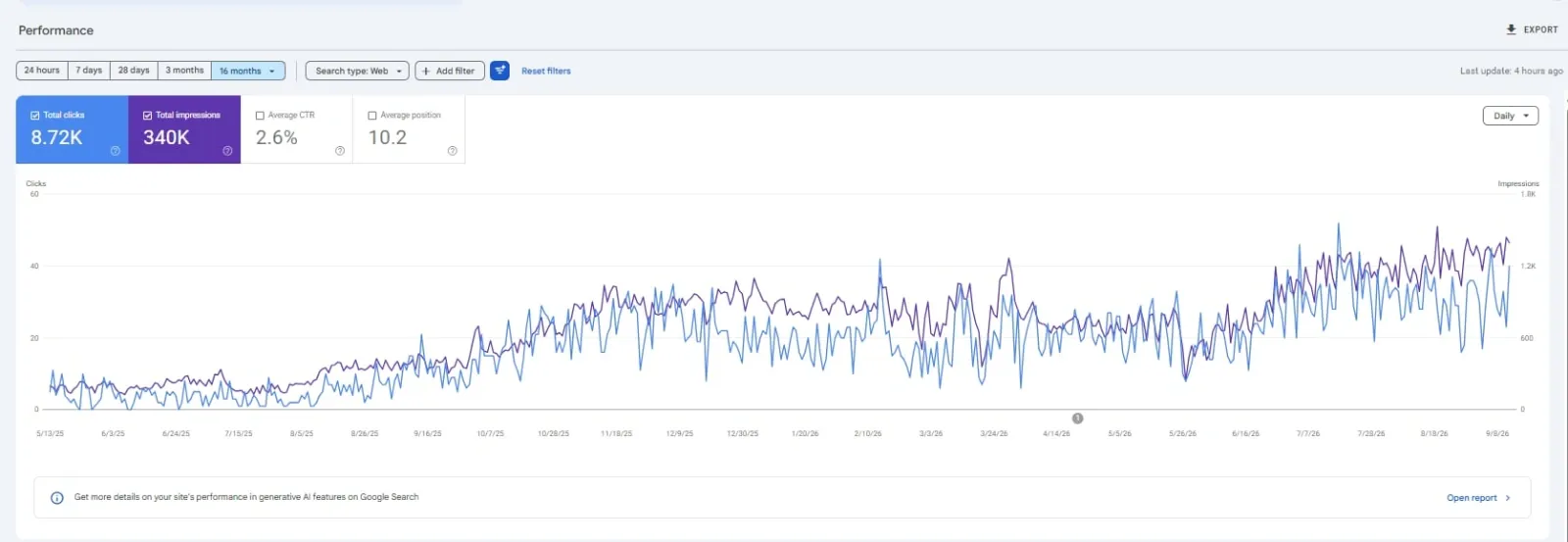
Local SEO, Google algorithm-update recovery, and bilingual content work, including recovering a site hit by a spam update.

Google Search Console performance report over 16 months: 8.72K total clicks and 340K impressions, with clicks and impressions climbing steadily
Search Console, 16 months on one site: 8.72K clicks and 340K impressions, climbing through a core update rather than dropping.

The differentiator

Being quotable by AI answers

A growing share of searches end without a click. Those systems quote self-contained sentences from sources they can identify and trust. Most sites have not started on any of this.

  • Self-contained paragraphs

    Each one makes sense lifted out of the page.

  • Consistent identity

    Same name, role and location everywhere on the web.

  • Complete structured data

    So a machine can parse what your business is.

  • Facts without JavaScript

    Readable by anything that does not run a browser.

Certified in

  • Google Ads Search
  • Meta Digital Advertising
  • Google Analytics

Common questions

What people ask before hiring me

Still unanswered? Send me a message. I read every one myself.

How long does SEO take to work for a small business?

Technical fixes can move things within weeks because you are removing obstacles. New content competing on anything meaningful usually takes three to six months to settle, longer in competitive markets. If someone guarantees page one in thirty days, they are either targeting searches nobody makes or planning something that will cost you later.

My traffic dropped after a Google update. Can it be recovered?

Often, but honestly not always, and it depends entirely on what caused it. The first step is diagnosis rather than action: which update, which pages, and did rankings drop or did the searches themselves change? Sites hit for thin or duplicated content can usually recover with serious rework. Sites hit for manipulative link building take longer. I have done this work, including a spam-update recovery, the honest version is that recovery is measured in months and some pages never come back.

Do I need SEO if I am already running Google Ads?

They answer different questions. Ads buy visibility now and stop the moment you stop paying. SEO compounds slowly and keeps working. If you need leads this month, start with ads. If you want a cost per lead that improves over years, you need both, and the search data from your ads is genuinely useful for deciding what content to build.

What does a freelance SEO consultant do that an agency does not?

You talk to the person doing the work. There is no account manager relaying your question to a specialist and relaying an answer back a week later. The trade-off is real: I am one person, so I am not the right choice for an enterprise site needing several specialists at once. For a small business, that trade usually favors the freelancer.

How do I know whether my SEO consultant is doing a good job?

Ask for Search Console access on day one and look at it yourself. Impressions and clicks for pages that matter, and whether the pages being worked on are gaining or losing. Be wary of reports built only from a rank-tracking tool showing terms nobody searches. Real progress is visible in Google’s own data, and you should have direct access to it.

Do you do link building?

Not the kind you can buy. Paid link schemes are exactly what spam updates target, and I have spent time cleaning up after them. What does work is having pages worth citing, being consistent about who you are, and earning mentions through real relationships. It is slower and it does not get penalized.

Can you help my site show up in ChatGPT and AI Overviews?

To an extent, and it is a real part of the work now. Those systems favor content they can extract cleanly and sources they can identify: self-contained factual sentences, consistent identity across the web, complete structured data, and facts readable without JavaScript. Nobody can guarantee an AI mention, but most sites are doing none of this, so there is usually straightforward ground to gain.

Lost traffic, or never had any?

Send me your domain and Search Console access if you have it. I will tell you what I see, including if the honest answer is that your problem is not SEO.

Get in touch